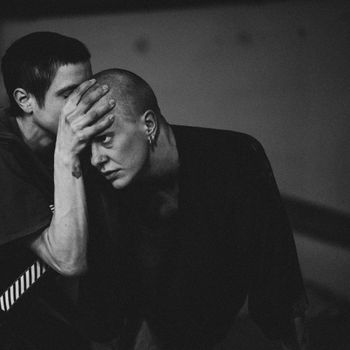
Damnat is a performance for two performers, and a chef by Teo Ala-Ruona and the working group. Through movement research, the work challenges medicalized modes of thinking that divide the body into separate parts, focusing in particular on the brain–gut axis. It examines diagnostic language as a system that organizes bodily functions and shapes social behaviour.
Through devoted movement practice that strives toward metaphysical shifts in body and psyche, growling vocalizations, and staged character development, the work subverts expectations of the body and of communication. Damnat pushes aside classifications that frame body parts as either normal or pathological, confronting the audience with a body whose distortions unfold across linguistic, physical, and symbolic registers. The choreography emerges from an intensive, multi-year shared practice of dance, movement, and character research between Ala-Ruona and the performer, Mina Tomic.
Damnat follows Ala-Ruona’s previous works Lacuna (2021) and Parachorale (2024). Damnat is a co-commission with Zodiak – Center for New Dance and co-production by Toaster, Copenhagen. The work will premiere in Pannuhalli, Dance House Helsinki, in May 2027. On stage Ala-Ruona is joined by dancer/choreographer Mina Tomic. The performance also features a food artist Pola Sutryk, who prepares food on stage. The dramaturg is Ami Karvonen, sound designer is Tuukka Haapakorpi, light designer is Sofia Palillo, costume and spatial designer is Teo Paaer and producer is Sanna Ritvanen.
During the Kanuti Gildi SAAL residency, the working group concentrates particularly on the designers’ contributions, on developing Sutryk’s abstract jelly sculptures referencing various organs, and on fine-tuning Ala-Ruona's and Tomic's practice of character creation through dance. In addition, we read texts together and watch reference films and performance recordings as part of the research process.
Teo Ala-Ruona is an interdisciplinary artist based in Helsinki, working in the expanded field of performance at the intersection of choreography, contemporary theatre, and visual arts. His practice seeks an embodied metaphysical transformation that shifts the attunement of human corporeality, navigating the intersections of linguistic, somatic, and social existence. Approaching trans embodiment as a critical dissection of society’s conception of the body, Ala-Ruona’s work aims to expand our understanding of what a body can be. Rooted in embodied practice, philosophy, and theory, his work considers the performer as both a reflective surface and an active agent in negotiating pre-given categories.
Ala-Ruona’s work has recently been presented at the Biennale Architettura (Venice), the Performa Biennial (New York), the Fundació Joan Miró (Barcelona), the Vilnius Biennial of Performance Art (Vilnius), the Finnish National Gallery Kiasma (Helsinki), and the Institute of Contemporary Arts (London). Ala-Ruona is an associate artist at the Zodiak - Center for New Dance for the period 2025–2028.